PARK(ING) DAY – CREATE A PUBLIC PARK FOR A DAY

PARK(ing) Day is an annual worldwide event where artists, designers and citizens transform metered parking spots into temporary public parks.”

The annual PARK(ing) Day is just one month away, on Friday, September 19th, 2014. It is easy to participate. First, sign up for a permit through DDOT. Then follow the PARK(ing) Day manual. You can create a park for just an hour, a few hours, or the entire day. DC’s Office of Planning participated last year along with environmental groups and design firms. The project started in San Francisco in 2005 by Rebar and has grown internationally. Don’t forget to add your park to the 2014 map!

Read articles about PARK(ing) Day 2013 in the Washington Post and Greater Greater Washington. Register  for your DC permit. See the manual to create your park.

BUILDING NEW BUSINESS WITH PUBLIC INTEREST DESIGN

Photo of Thomas Fisher from publicinterestdesign.org

Thomas Fisher writes about four emerging fields that Architects should expand their practice into to stay competitive.

“We should take a more expansive view of architectural practice. The four fields [on the next page], which have emerged in response to the pressing needs of our current age, represent inventive combinations of existing disciplines. These fields are among the most visible examples of the entrepreneurial revolution happening in our midst.”

Geodesign which uses programs like GIS to understand the effects of buildings on the natural environment. Service Design which plans and organizes processes to improve the interaction between service provider and customers. Experience Design which organizes processes with focus on user behavior and having a positive experience. Public Interest Design which emphasizes the creation or redesign of products, environments, and systems, with a clear human-centered approach.

Read the entire article in Architect magazine. *Listen to Thomas Fisher speak about “Redefining Practice.

ARLINGTON FOOD ASSISTANCE CENTER – INSCAPE PUBLICO

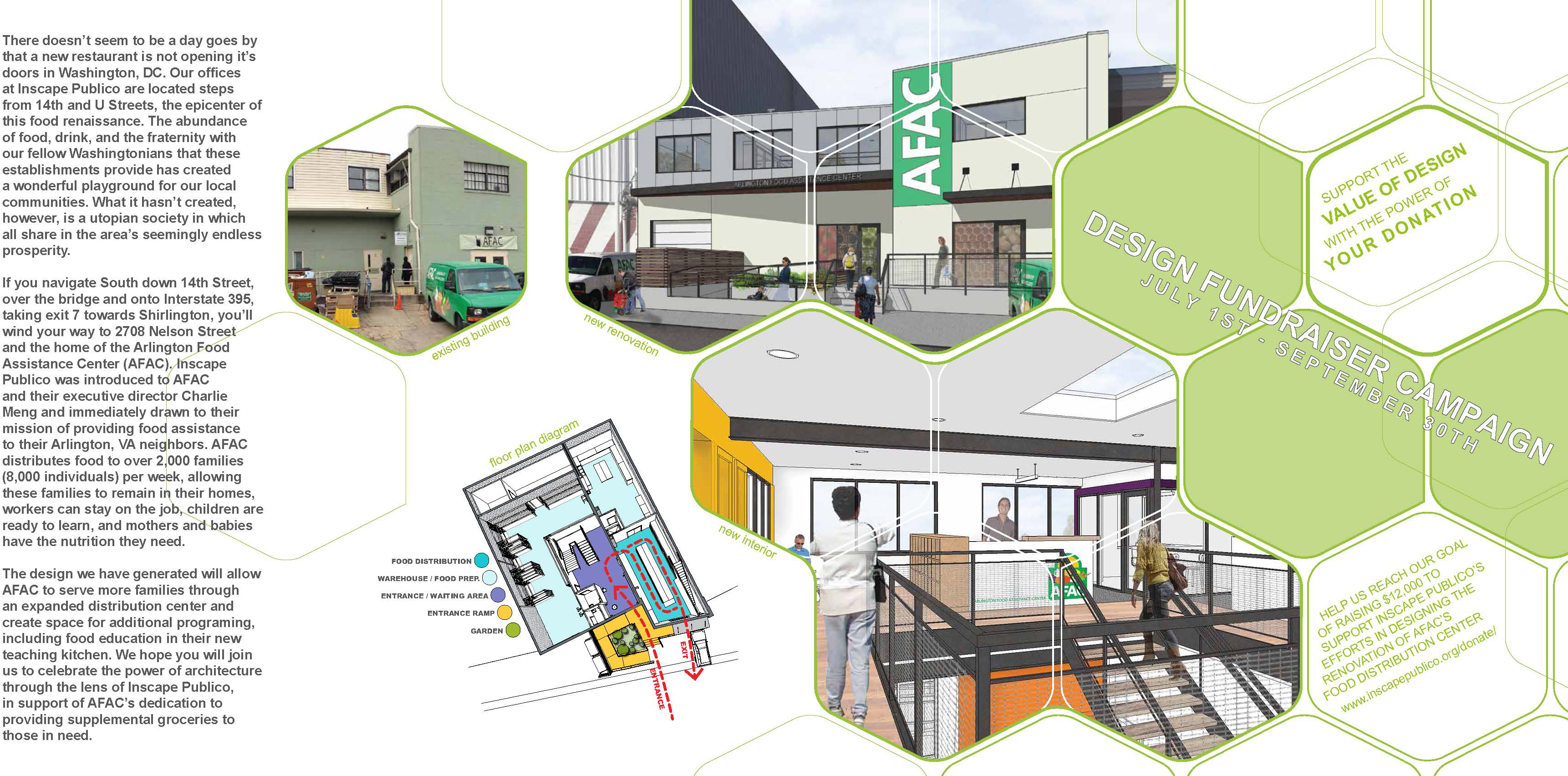
AFAC campaign by Inscape Publico

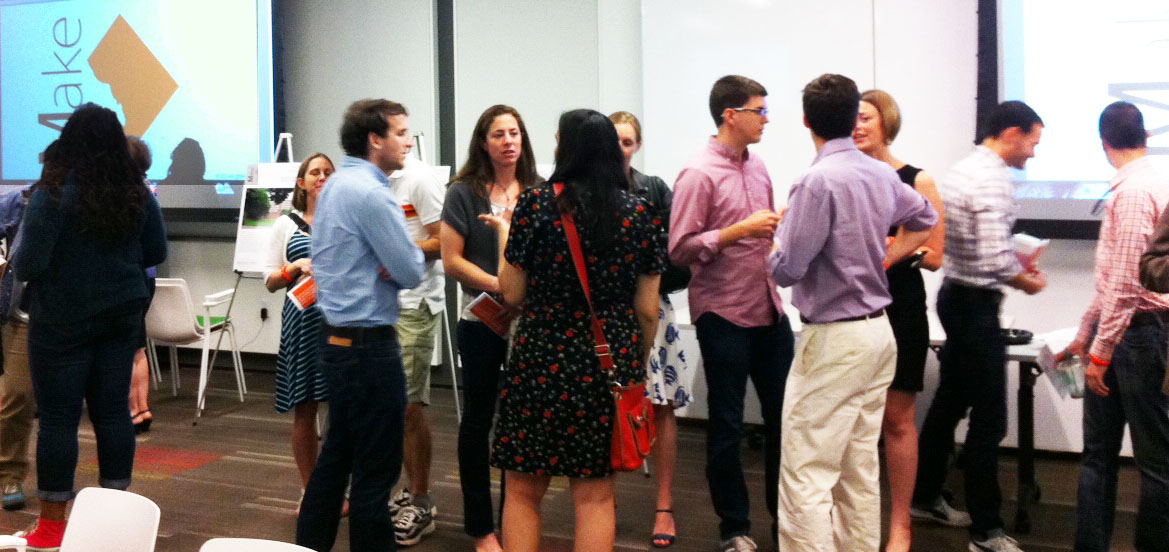
Inscape Publico recently hosted a happy hour as part of their summer fundraising campaign. This year the featured project is the Arlington Food Assistance Center’s distribution facility. Plans include a renovation of the existing facility and a new teaching kitchen to promote food education. Inscape Publico is a nonprofit (501c3) architecture firm which provides design services for other nonprofit organizations. Their goal is to design for the public good and to inspire positive change in communities.

“Support the value of design with the power of your donation.” Donate here. Read more about Inscape Publico in the Washington Business Journal.

LIVING BUILDING CHALLENGE 3.0

Living Building Standard 3.0 from ILFI

Some refer to the Living Building Challenge as ‘beyond LEED’ because of its rigorous building performance measurements and it’s holistic interpretation of sustainability. The triple bottom line requirements include three categories for equity as well as many ambitious environmental goals, like Net Zero energy and water. If you have heard of Net Zero, it is a partial certification of the Living Building Challenge. Another unique feature for certification is that project performance is measured during the 12 months after occupancy to guarantee that all requirements have been met. The Living Building Challenge is run by the International Living Future Institute which organizes an annual conference, and at this year’s conference they released latest version of the LBC, Version 3.0.

To learn more about the Living Building Challenge 3.0, attend the COTEdc event Monday, August 4th from 5:30-8:00pm at the District Architecture Center. Or click on the image above to read about the new standards.

DESIGNING FOR DISASTER: NATIONAL BUILDING MUSEUM EXHIBIT

Katrina. Washington Post

The National Building Museum, in Washington DC, is featuring an exhibit on resiliency that will run through August 2nd, 2014 2015.

“Design can reduce our risk and increase our resiliency to the most destructive forces of nature. From seismic retrofits and safe rooms to firebreaks and floodplain management, this exhibition explores how regional, community, and individual preparedness are the best antidotes to disaster.” 

Plan your visit to the NBM. Can’t make it to the exhibit? Check out the Washington Post article and the NBM Designing for Disaster blog MitigationNation.

ECODISTRICT IN SWEDEN – HAMMARBY SJOSTAD

I recently visited Hammarby Sjostad, an ecodistrict in Stockholm, Sweden. The site was originally intended for an Olympic Village, but when Sweden lost the bid for the 2004 Olympics, they continued with the brownfield redevelopment of this former industrial area. Now it is a sustainable residential neighborhood that can be reached by boat, electric train, bike, or a biogas bus. Unique to this Stockholm neighborhood is that all apartments are connected to one district heating system which is fueled by their collective household waste. Some apartments feature biogas stoves and solar hot water. Exceptional landscape architecture connects the waterfront neighborhood with its natural surroundings, like a storm water managing canal, reintroduced vegetation in the main waterways, and a boardwalk with a variety of fun seating. Click on the photos above to see the full image. Interested in ecodistricts? Attend the EcoDistricts Summit in Washington DC September 24-26.

Read the Hammarby Sjostad case study from EcoDistricts.

NEW EXECUTIVE DIRECTOR FOR ARCHITECTURE FOR HUMANITY

AFHDC

(left to right) AFH Executive Director Eric Cesal, AFH-DC members Marcus, Matt, and Lindsay, and AFH Program Coordinator Audrey Galo

Today members of the DC Chapter of AFH met up with Eric Cesal, the new Executive Director for Architecture for Humanity. Eric is a Washington DC native and was in town visiting with national partners, the American Institute of Architects, among others. AFH is an international nonprofit, with headquarters in San Francisco, that provides design services for national and international communities in need. There are local Chapters of AFH in nearly every major city including Washington DC, which boasts one of the oldest. Join your local chapter and volunteer today. You do not have to be a designer to sign up! Engineers, financiers, nonprofitiers, all advocates of design for good are welcome.

Join the DC Chapter of AFH and find out about local events. Read more about Eric Cesal in Architectural Record.

EVERYONE DESERVES GOOD DESIGN

Image

Check out the beautiful new Impact Design microsite created by the folks from PublicInterestDesign.org. The latest news is that they will be rebranding their current blog to become the Impact Design Hub. The Autodesk Foundation is supporting this effort along with providing their software to nonprofits for free. Nonprofits can qualify through an online grant.

Learn more about the Autodesk Foundation.

JOSEPH’S HOUSE WINS PITCH NIGHT – MAKE DC

makeDC

MakeDC awarded $20,000 of professional design services to Joseph’s House, a nonprofit that provides end-of-life care for homeless men and women in Washington DC. With a unique twist on the traditional design competition, MakeDC organized this competition where worthy clients presented their desire for design services. A panel of judges then voted for the winning team along with the  public who attended the event. Joseph’s House requested a meditation garden which will welcome neighbors to mingle with their guests receiving end-of-life care. MakeDC is a Public Interest Design firm in the Washington DC area.

See more about MakeDC.

ARCHITECTURE & ETHICS – ACTIVIST DESIGN

Photo © Mark Warren courtesy Architecture for Humanity For the Baguinéda center, which opened in Bamako, Mali, in 2010, architects Michael Heublein and Quarc Design used local stone and earth block to recall traditional Malian adobe and mud-brick buildings.

The latest issue of Architectural Record highlights Architecture and Ethics. There is a great article on activist design, also known as public interest design, where Lamar Anderson describes its history within the field of Architecture. Listing many organizations such as Design Corps, Community Design Centers, Public Architecture, Architecture for Humanity (see the local chapter), Architects/Designers/Planners for Social Responsibility, and MASS Design Group, Anderson gives a full picture of what is happening with this movement and where it hopes to go. They key to make this last? Funding, nonprofits, & research.

“In our own time of growing humanitarian crisis, global climate change, and mounting concern over income inequality, activist architects are no longer relegated to the field’s fringes…Increasingly, public-minded architects are thinking like economists, widening their focus beyond buildings themselves to the communities they support.”

Read more by Lamar Anderson at Architectural Record.